Free Shipping Over €50
Klarna available at checkout
2 Year Product Guarantee

Indispensable. Kärcher wet/dry and dry vacuum cleaners provide optimum solutions for industry, commerce, automotive industry, building service contractors and trades. They impress with their high quality and long service life, innovative filter engineering and extraordinary operating comfort.


Wet and dry vacuum cleaners are machines for trade and industry, as well as the hotel and restaurant trade. They eliminate both dry and damp dirt, including liquids. Commercial wet and dry vacuum cleaners are indispensable for removing coarse and fine dust, particularly for diverse work on building sites or in workshops.
Whether it's for liquids or large amounts of fine dust, they are a cut above normal dry vacuum cleaners for private or commercial use, primarily with regard to the type and amount of contamination that they can eliminate. What's more, the housing, rollers, power cables, etc. meet the demands of daily use in challenging conditions.
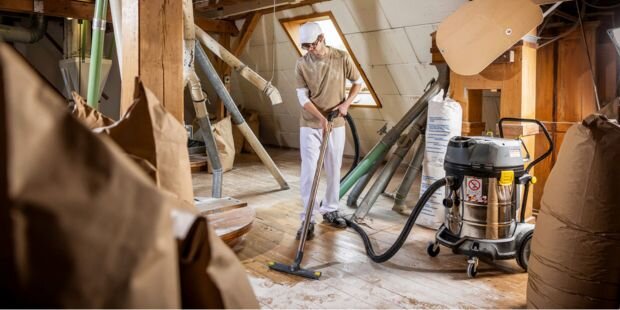
Top quality does not happen by accident – it's hard work. Especially on construction sites and in workshops, large quantities of dry dust accumulate, sawdust is generated, material residues fall onto the floor and get stuck in machines. Our fine dust vacuum cleaners are tailored to suit precisely these challenges. The patented Tact filter cleaning technology makes it possible to vacuum large amounts of fine dust without the need for a filter bag. This allows the whole size of the suction container to be used, plus there are no costs for filter bags. Suction power remains consistently high so that you can work at the height of efficiency without interruptions – for both vacuuming directly on the power tool, as well as removing dust deposits.
Our Ap class vacuum cleaners have been designed with semi-automatic filter cleaning for small to medium quantities of fine dust. Of course, they are also brilliant at handling coarse dirt and liquids – a true all-rounder.


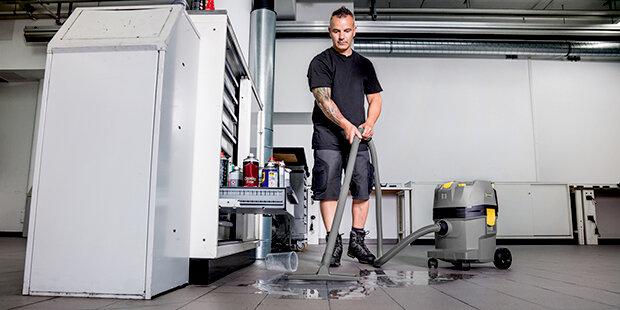
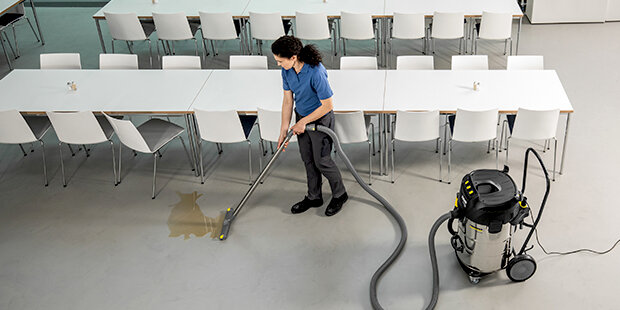
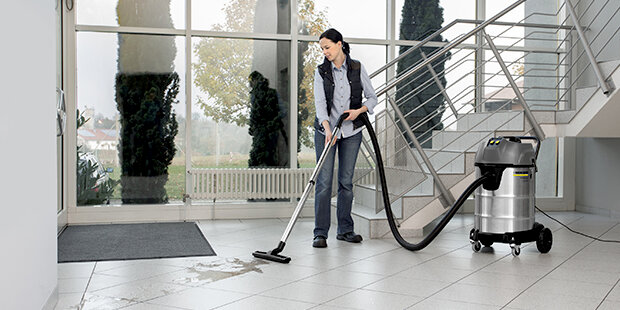
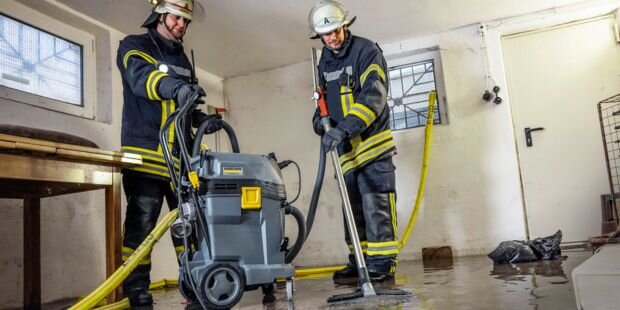
Large fluid volumes are difficult to remove without a wet vacuum cleaner. Moisture damages the floor and may cause accidents due to the slipping hazard. These challenges are fun to tackle with our wet vacuum cleaners. Whether you're using them to deep clean floors or remove spilled liquids, it doesn't matter – all of our wet and dry vacuum cleaners eliminate small to large fluid volumes quickly and reliably. If you need a machine primarily for wet vacuum cleaning, our standard class vacuum cleaners are the right choice for you.
Safety vacuum cleaners give you peace of mind. Use them to vacuum hazardous dirt easily – and in the correct way. If you work in an environment with respirable dusts, have anything to do with carcinogenic materials or have even been exposed to asbestos, Kärcher safety vacuum cleaners are your saving grace, allowing you to work in a sustainable and healthy way. Certified flat pleated filters of dust class H keep the vacuumed substances where they should be – inside the vacuum cleaner. Our patented Tact filter cleaning system allows you to vacuum for long periods with powerful suction. When you can easily and safely vacuum up harmful substances, you can concentrate on the important stuff, your work.


In order to cope with the challenging demands required by users on construction sites, in workshops or industry, the Kärcher wet and dry vacuum cleaners offer different functional principles depending on the type of dirt.
A distinction is made between dry and wet contamination, where the specific composition of the dirt plays an important role. Is it coarse-grained or dusty dirt? Does the contamination have a low or high viscosity? There's a Kärcher wet and dry vacuum cleaner to suit dirt of any state, from solid to liquid.
The liquid is transported into the container via a suction hose thanks to the bypass blower vacuum generated in the container. To prevent liquids reaching the fan in the event of overfilling, a mechanical float system interrupts the air stream, whereby a float blocks the suction channel or an electronic automatic cutoff switches off the vacuum cleaner.

When the liquid in the container increases, the system pushes the float upwards until it blocks the suction channel, preventing overfilling that would lead to the suction blower being flooded.

If the liquid in the container joins the electrically conductive contacts, the machine switches off to prevent overfilling.
A vacuum is generated in the container by a bypass blower, which transports dusts inside the container through a hose. As a result, the dirt is separated or filtered through a flat filter or cartridge filter. Over time, dust will clog into the filter, reducing the suction power. To prevent this, there are models with the option of cleaning the filter semi-automatically or fully automatically. For a short period, an air flow is generated that flows through the filter from the clean side, which cleans the filter. Thanks to the design of the suction hose port on the container, the dirt is made to rotate and heavy, coarse particles settle directly on the container floor, like a cyclone.
When vacuuming dust without using a filter bag, the filter has to be cleaned regularly to minimise loss of suction power. Many vacuum cleaners have integrated filter cleaning to do this conveniently.

All-purpose
With semi-automatic Ap filter cleaning, users can determine the cleaning intervals themselves. To do so, press the button three times in quick succession when the machine is switched on – preferably with the suction hose port closed (power cleaning).

Triggered air cleaning technology
On machines in dust class L, the filter cleaning interval for automatic filter cleaning can be set in two stages. At the MIN setting (3), cleaning happens every 60 seconds. At the MAX setting (2), cleaning happens every 15 seconds. When vacuuming liquids or working with filter bags, the Tact function remains switched off (1).

Triggered air cleaning technology
With automatic filter cleaning, the machine selects the perfect filter cleaning interval itself on machines in dust classes M and H. An electronic differential pressure measurement decides whether cleaning takes places every 7, 15, or 60 seconds, or not at all.

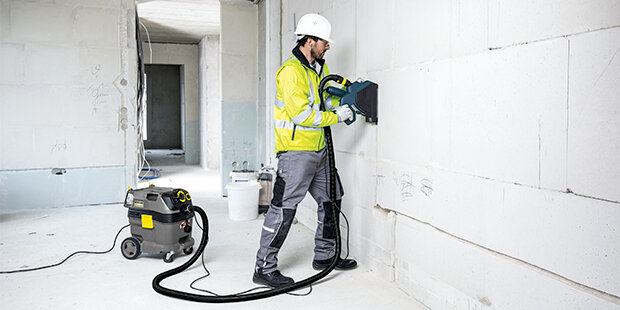
We want to do our bit to protect workers in the construction industry from the dangers of fine dust. So, we've developed a range of vacuum cleaners for removing wet and dry dirt and dust – with the option of vacuuming directly at the dust source thanks to chip and dust suction. We've gone one step further with our latest generation of wet and dry vacuum cleaners in the Tact H and M class.
Thanks to a range of functions such as our new, sensor-controlled automatic filter cleaning system (Tact), Kärcher Professional vacuum cleaners and dry vacuum cleaners detect when the flat pleated filter needs cleaning – then they briefly reverse the air flow and blow air through the filter. As a result, users can work without losing any suction power and without any interruptions. This revolutionary system leads to never-seen-before quantities of dust that can be vacuumed without manual filter cleaning, as well as significantly reduced noise if only small amounts of dust are present.
Thanks to this highly efficient filter cleaning, the powerful Tact vacuum cleaners are perfect for both typical and hazardous dusts. The filters have an unparalleled service life – they only need changing after vacuuming 180 kilograms of fine dust (category A mineral dust). As a result, you can enjoy longer periods of uninterrupted work with consistent suction power, as well as better protection against fine dust.


Dust is a complex mixture of air and solid particles of different shapes and sizes. The chemical composition and physical characteristics may also vary significantly. Dust is categorised into the L, M or H classes using these variables depending on the hazard levels. Fibres, such as the particularly dangerous asbestos and mineral fibres (when < 5 µm), can also penetrate deep into the respiratory tract. The exact identification of the individual dust classes is therefore important in order to be able to select the right vacuum cleaner when the danger has been assessed.
Class L vacuum cleaners are particularly suited to vacuuming soft wood, chalk and plaster dust. Dusts in the L class represent a moderate risk. There are no particular precautionary measures for disposing of them.
The L class, upgraded. Suitable for vacuuming dust and dirt generated by the following materials: hardwood, panel materials, paint dust particles, ceramics, concrete and brick. The M class is the lowest legally required class for use on construction sites.
H class vacuum cleaners are ideal for vacuuming large amounts of both safe and hazardous/highly carcinogenic substances, such as asbestos dust, lead, coal, nickel, cobalt, copper, cadmium and mould.
Dust class | Permeation rate | Suitable for | Use for |
|---|---|---|---|
L | ≤ 1.0% |
|
|
M | < 0.1% |
|
|
H | < 0.005% |
|
|
Special requirement: Asbestos* | < 0.005% |
|
|
Explosive types of dust (ATEX zone 22) | Like dust class L, M or H with special requirements |
|
|
A vacuum cleaner is always only as good as its filter
It has never been safer to show true colours. Our filters are colour-coded to indicate their application of use. Brown signifies wood and fibre dust. Red indicates HEPA. Black denotes the toughest applications. Blue means they can be used anywhere. And green stands for dry dust and high cost-effectiveness.

Our cartridge filter fits into the latest generation of all single-motor Kärcher Tact vacuum cleaners. The eight cartridges with PTFE coating work extremely efficiently for wood and fibre dust of any kind. Certified for M and L dust classes. Guaranteed dust separation rate: 99.9%.
Dust class: M + L

The first cleanable H filter for wet and dry vacuum cleaners. Single-stage and available exclusively from Kärcher. Certified for dust class H. Guaranteed dust separation rate: 99.995% (HEPA).
Dust class: H

We have the best filter solution for applications that create a great deal of dust, e.g. sanding fresh concrete or working with toners: our PTFE filter. Can be used in all NT Tact models. Certified for M and L dust classes. Guaranteed dust separation rate: 99.9%.
Dust class: M + L

These PES filters (standard feature in our new NT Tact vacuum cleaners) provide excellent results for both wet and dry applications. Certified for M and L dust classes. Guaranteed dust separation rate: 99.9%.
Dust class: M + L

These paper filters are an excellent choice for dry applications, including in terms of price. Can be used in all NT Tact vacuum cleaners. Certified for M and L dust classes. Guaranteed dust separation rate: 99.9%.
Dust class: M + L
Construction dust is a general term to describe the types of dust that typically occur when working in the construction sector. If not properly controlled, the dust types may have serious negative impacts on your breathing and health. The new Kärcher wet and dry vacuum cleaners stand out from the crowd thanks to improved filter technology, which helps to control the dust in your environment, as well as protect you and others from it.
Construction dust is a general term to describe the types of dust that typically occur when working in the construction sector. These dusts are more than simply annoying – if not properly controlled, these dust types may seriously harm your breathing and health. Long periods of exposure to some types of dust may cause life-threatening lung illnesses, even leading to death.
We're on familiar ground with fine dust particles that circulate in the atmosphere day to day, such as human skin cells, textile fibres and even particles of burned-up meteorite. However, workers in the construction industry face significantly more hazardous types of dust.
There are three main categories for dust generated during cutting, filing, sanding or any other way of breaking up materials:

Concrete, bricks, tiles, mortar and sandstone (also known as "respirable crystalline silica")

Softwood, hardwood and wood products, such as MDF and plywood

Plaster (e.g. in plasterboard), limestone, marble and dolomite
Our lungs simply aren't built to deal with fine dust. Let alone large volumes of it. And it's those large volumes that can be extremely dangerous. Chronic lung diseases are therefore number 3 in illness statistics. Treatment costs several billion euros. How much is your health worth to you?
Silica and asbestos dust are particularly hazardous and may cause cancer.
Poisonous or carcinogenic dust from lead, cadmium, vanadium or manganese not only damages your lungs, it also affects other organs like your liver and spleen. This kind of dust is created during welding work among other tasks.
Wood dust (such as oak and beech dust) can cause nasal cancer in the long term.
Allergenic dust has a plant or animal origin and occurs during cleaning work in or on buildings that are contaminated by bird droppings, for example. Mould spores or microorganisms can also cause allergic reactions.
Fibrinogenic dust causes scar tissue to form and progressively changes the composition of your lung tissue after frequent exposure over longer periods. Pneumoconiosis, also know as black lung, caused by quartz and asbestos is one of the most prevalent recognised occupational diseases.

Dust that isn't created in the first place cannot endanger anyone. There are many different ways to prevent dust forming. And if we cannot prevent dust, we can still bind it, vacuum it or block it from entering our lungs with protective clothing and dust masks.