




Limpeza de fachadas

As fachadas podem ser feitas de diversos materiais, como gesso, pedra natural, vidro, metal ou madeira. Eles conferem a um edifício uma aparência individual. Para manter o seu apelo visual e valor durante o maior tempo possível, é necessária uma limpeza regular da fachada do edifício. Existem várias técnicas disponíveis, especialmente quando se utilizam equipamentos adequados, como máquinas de limpeza de alta pressão, jatos de areia/água e jatos de gelo seco, que são utilizados profissionalmente dependendo do material e do tipo de sujidade.

Dica – Cozinhe no vapor:

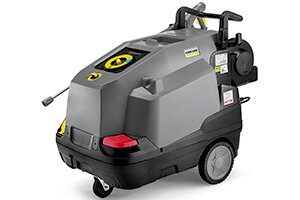
Se houver sujeira teimosa, como tinta ou revestimentos de betume, ou superfícies sensíveis, a configuração de vapor de uma máquina de limpeza de alta pressão pode ser útil. O vapor, que atinge até 155 °C, permite uma limpeza intensiva da fachada e é suave para a superfície devido à baixa pressão de trabalho.

How does it work? Sandblasting

In the low-pressure particle blasting process, known as sandblasting, a blasting gun is supplied with compressed air via a construction compressor. In addition, a very fine, soft abrasive and water are added to the air in the mixing chamber. It is important to select the properties of the blasting type to match both the dirt and the original facade surface type. The mixture of air, water and abrasive exits the nozzle of the gun, and the air pressure, water and abrasive quantities can be individually regulated. In this way, facades can be cleaned with minimal abrasion.

How does it work? Dry ice blasting

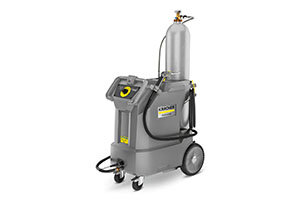
Dry ice blasting is a particle blasting process in which CO2 pellets of about 0.5 to 3 millimeters in size are used as blasting material. The dry ice pellets impact the surface at a temperature of -79 °C and a velocity of 150 m/s. In the process, they release their kinetic energy. The cold also makes the dirt brittle and fragile, so that it comes off more easily.

Another effect of facade cleaning with dry ice is that parts of the frozen carbon dioxide penetrate the cracks of dirt crusts or paint coatings, change from the solid to the gaseous state and literally break up the dirt through this increase in volume. All that remains are the radiated substances, which, depending on their quantity and composition, are either blown off with the compressed air available or picked up with suction cups.

Since the process is barely that abrasive and no abrasive residues, dirty water or moisture remain, sensitive facades can be cleansed of dirt gently and with minimal exertion.

Cleaning metal facades

To reduce dirt on a facade, a high-pressure cleaner can be used. Cleansing brushes with soft natural hair or polyamide brushes (rigid or rotating) should be used. The reason is that water flows out through the large opening on the brush as a low-pressure jet. This avoids damage to the insulating layer behind the facade, and yet even strongly adhering dirt is usually removed quickly and in a water-saving manner.

To enhance facade cleaning, a suitable cleaning agent can be used. To extend the exposure time, the cleaning agent can be applied in sections in advance using a pump spray bottle.

If dirt has become crusted and well-formed over the years, a cleaning agent with abrasive additives is used in combination with suitable facade pads made of white, scratch-free fleece to remove them. This work can be done manually or mechanically with the support of electrically operated handheld machines.

A person uses a Kärcher telescopic pole to clean a metal facade
Metal facade cleaning with a brush
Metal facade

Finally, all cleaning residues are rinsed off again with clear water before the facade surface is stripped or leveled. Telescopic pole systems or a hoist can be used for this purpose. To maintain a uniform appearance for as long as possible, a preservative can be applied and carefully buffed out after the metal facade has been cleaned. In this way, the surface is also protected against emissions.

If there’s solid debris, such as plaster, mortar or concrete residues on metal facade s, this can be removed with wooden or plastic spatulas. This should be done as soon as possible, as the materials are strongly alkaline and can therefore cause irreparable damage, especially to anodized aluminum. Once the facade has been freed from any debris, initial cleaning can begin. The procedure for subsequent cleaning measures is analogous.

Cleaning wooden facades

Not all wooden facades are suitable for high-pressure cleaning. The facade should be made of untreated solid wood (hardwood or softwood) and be such that no water can reach underlying components (closed facade) or that the components behind the facade cannot be damaged by water. Whether the boards of the facade are laid vertically or horizontally, on the other hand, is irrelevant.

If wood is exposed to UV radiation, lignin, one of the main components of wood, starts breaking down. This leads to natural graying. To reverse this effect, hot water high-pressure works well. The facade cleaning is carried out without chemical agents and is therefore environmentally friendly. Thanks to the high temperature, work can be done gently and with little pressure, and dirt is dissolved much faster than with cold water. Dust, pollen, spores and mold on the surface can also be removed and in some cases even killed by the hot water. The result is an extensive restoration of the original appearance, depending on the degree of graying and the cleaning frequency.

Wooden facade with a window

Para fachadas de madeira dura resistente, como o carvalho, recomenda-se o uso de máquinas de limpeza a alta pressão com água quente, com uma pressão de cerca de 100 bar e uma temperatura entre 60 °C e 80 °C. Madeiras mais sensíveis, como o abeto, podem ser tratadas com uma pressão de cerca de 50 bar. Deve-se usar um bico de jato plano e um ângulo de 25° a 40°. Não devem ser utilizados bicos rotativos, pois podem causar danos. Se a aplicação for muito abrasiva, isso pode ser minimizado reduzindo a quantidade de água ou aumentando o diâmetro do bocal.

A distância entre o bocal e a superfície deve ser de cerca de 20 centímetros, limpando a fachada de madeira ao longo da direção do veio. Também é uma boa ideia molhar toda a superfície antes e, em seguida, trabalhar de cima para baixo, para que a parte inferior da fachada não absorva a água suja que escorre. Como passo final, toda a fachada deve ser enxaguada novamente.

A person cleaning a plaster facade

Limpeza de fachada de gesso

A aplicação de reboco nas paredes exteriores é uma prática arquitetónica comum que oferece opções versáteis de textura e cor para as fachadas dos edifícios. Para garantir que a fachada de um edifício mantenha o seu apelo estético, é necessário realizar uma limpeza regular, além de repintar quando necessário. As nossas dicas abaixo irão ajuda-lo na limpeza de fachadas de gesso.

A person wearing protective clothing and a helmet is standing on a rooftop and cleaning a stone facade with a Kärcher Pressure Washer

Limpeza de fachadas de pedra

Embora a beleza das fachadas de pedra natural seja celebrada há séculos, a arte de limpa-las pode ser um pouco complicada. Antes de limpar fachadas ou pátios de pedra natural, deve primeiro identificar o material com que está a lidar, bem como o estado geral da fachada ou do pátio. Também é importante avaliar o grau de sujidade e os diferentes tipos de sujidade. Com base nesta análise, pode determinar quais medidas devem ser tomadas e adaptar os métodos de limpeza em conformidade. Embora um tipo de pedra possa beneficiar da lavagem com pressão, a limpeza com jato de areia a baixa pressão pode ser mais adequada para outro tipo.

A person cleans a slanted glass facade with the help of a water-fed pole

Limpeza comercial de janelas

As fachadas de vidro conferem uma aparência transparente aos edifícios e desempenham um papel importante na arquitetura moderna. Diferentes edifícios têm diferentes tipos de vidro, e é importante limpa-los com cuidado e eficiência. Para a limpeza pós-construção, as superfícies de vidro sensíveis a riscos, como o vidro temperado, devem ser manuseadas com cuidado especial. Para limpezas padrão, é prática comum usar água purificada. Este tipo de água remove a sujidade sem a necessidade de produtos químicos adicionais e, ao contrário da água da torneira, seca sem deixar calcário e outras manchas de água dura.

Legal precautions: follow local regulations

Facade cleaning always takes place in a public space, so the legal regulations must be followed. Wastewater removal is subject to approval in many countries. If only dirty water is involved, the water can be discharged in many places after filtration and any collected solid debris must be disposed of. If a cleaning agent has been used, the water must usually be collected, filtered and neutralized. The relevant regulations must also be observed with regard to the use of blasting agents, the generation of dust, noise or waste gas.

Produtos adequados para a sua área de aplicação